
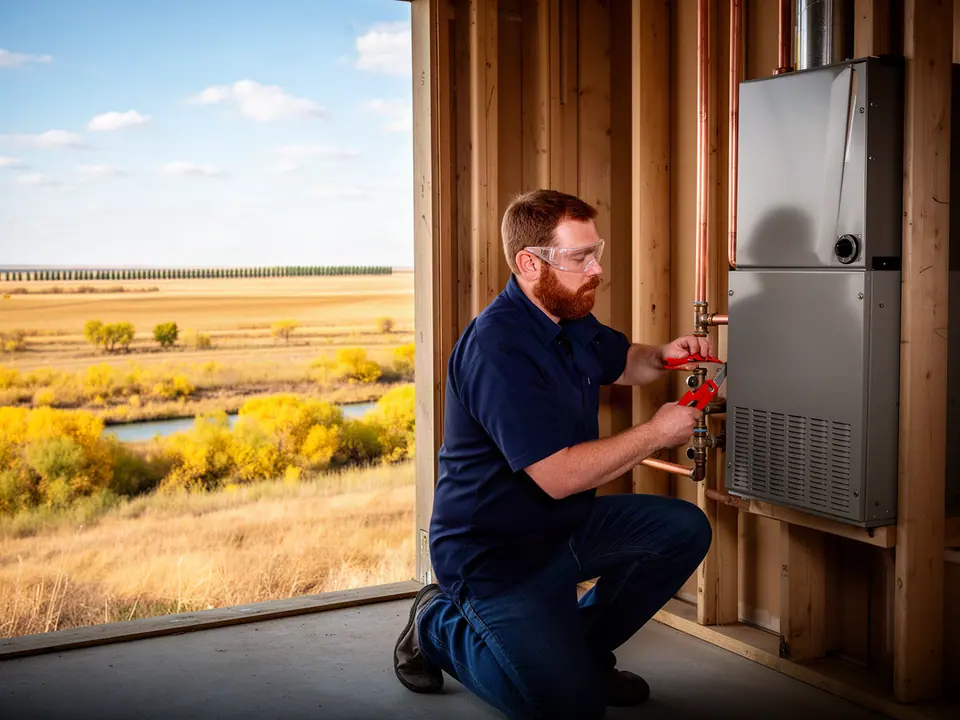
Heathbend Credit helps plumbing, heating and air-conditioning contractors in Minot, ND request funding for service trucks, work vans, stocked parts, replacement equipment bought for jobs, and payroll gaps. The page covers the service-trade cash cycle, matching options, what partners review and Ward County figures.
| Plumbing and HVAC firms with payroll, Ward County, ND | 28 with payroll in 2023 (CBP, code 238220) |
|---|---|
| Under five employees | 60.7% |
| Employers in ZIP 58701 | 18 (ZBP 2023) |
| Nonemployer plumbing and HVAC firms | 16 (NES 2024) |
Service Calls vs Installation Jobs
Service and repair work may be paid by card or check on completion. Installation and new-construction work is different: the contractor orders equipment, often a high-cost furnace, boiler, rooftop unit or water heater, plus pipe and fittings, pays technicians for days or weeks, and bills the builder or owner on a schedule.
A shop that grows its installation work can grow its cash gap with it.
Vans and Service Trucks: The Rolling Shop
The van is the shop. A plumbing or HVAC technician carries thousands of dollars of parts, tools and diagnostic gear on board, and a business adds vans as it adds technicians. Work van financing through an equipment loan or lease spreads the cost over the van's working life, with the vehicle as collateral.
- Upfitting such as shelving, ladder racks and inverters can sometimes be included if it is on the dealer invoice
- Used vans can be financed; partners check mileage and condition
- Leases can suit fleets that rotate vehicles on a schedule
See equipment financing for the loan-versus-lease comparison.
Parts Stock and Replacement Units
Holding common parts on the van and in the shop saves return trips but ties up cash. For a contractor whose parts room is growing, inventory financing or a line of credit can carry the stock. Replacement units bought for a specific job can be handled as part of that job's working capital, repaid when the customer pays.
Which Options Fit Plumbing and HVAC Contractors
| Need | Option |
|---|---|
| Additional van or service truck | Equipment financing |
| Furnace or boiler bought for a job | Working capital |
| Payroll between builder payments | Line of credit |
| Larger shop or warehouse | Term loan |
HVAC Profitability and What a Partner Reads Instead
It varies too much to give a figure, and we do not have local margin data. What a partner looks at is your own record: gross margin on installs versus service, how much of revenue is repeat maintenance agreements, and how quickly customers pay. A business with steady service revenue may read more favorably than one that depends on a few large installs.
An Illustrative Install Job
Illustrative only. An HVAC contractor wins a contract to replace heating equipment in a small office building for $48,000. Equipment costs $26,000, ordered on signing; two technicians spend two weeks on site. The customer pays 30 days after completion. For six weeks the contractor carries about $32,000 of costs. A line of credit drawn for that window and repaid on payment is one way to take the job; the owner compares its cost against the job's margin.
What Partners Commonly Review
- Business bank statements showing service and install deposits
- Large jobs in progress and what each is owed
- Vehicle and equipment list with existing loans
- Tax returns
The wider contractor picture is on the construction page.
Plumbing and HVAC Counts for Ward County, ND
County Business Patterns counted 28 plumbing, heating and air-conditioning contractor employers in Ward County, ND in 2023, with 257 employees; 60.7% had fewer than five employees. ZBP counted 18 in ZIP 58701 the same year. Nonemployer Statistics counted 16 such contractors without payroll in 2024 (NAICS 23822).
See the Minot, ND page for county and ZIP figures and the industries page for every sector.
By Heathbend Credit · Updated